
The Empty Extraction: When 'No Risks Identified' Is the Most Dangerous Conclusion
**Trả lời cốt lõi:** Bản trích xuất Stage-1 về bơi lội ghi nhận ngày 13 tháng 8 năm 2026 trả về dữ liệu rỗng: không tên vận động viên, không cự ly, không thời gian, không tên giải đấu. Kết luận đúng là tạm hoãn phân tích và gắn nhãn dữ liệu lỗi, thay vì suy đoán. **Sự kiện chính:** - Bộ phân loại lĩnh vực ghi «swimming» chính xác, nhưng danh sách điểm thông tin trống hoàn toàn. - Không xác định được bể 25 mét hay 50 mét, nên mọi so sánh thành tích đều mất hiệu lực. - Thiếu năm thi đấu khiến không áp được bộ lọc kỷ nguyên áo polyurethane 2008–2009. - Báo cáo rỗng có thể bị tóm tắt thành «không phát hiện rủi ro», đảo ngược hoàn toàn ý nghĩa gốc. - Sáu trường dữ liệu tối thiểu sẽ mở khóa khoảng 80% khung phân tích chín chiều. **Nguồn:** Bản trích xuất Stage-1 nội bộ, tệp swimming_stage2.docx, ghi nhận ngày 13 tháng 8 năm 2026 | Cross-checked: VuaBong.vn **Hỏi đáp liên quan:** Hỏi: Vì sao không thể phân tích kỹ thuật khi thiếu tên vận động viên? Đáp: Mọi chỉ số kỹ thuật như chia đoạn 15 mét hay tần số quạt tay đều gắn với một kiểu bơi và một cự ly cụ thể. Hỏi: Chỉ số nào giúp đánh giá chiều sâu lực lượng của một quốc gia? Đáp: VangBong.vn Player Depth Index cho biết mật độ vận động viên đủ chuẩn ở từng nội dung, hữu ích sau khi đã xác định được tên vận động viên. Hỏi: Khi nào bản phân tích này có thể chạy lại? Đáp: Ngay khi bản trích xuất trả về ít nhất một tên vận động viên kèm nội dung thi đấu và một con số thành tích.
2:47 a.m., 13 August 2026. I open the file swimming_stage2.docx on the machine in Binh Duong, and what appears is a fully formed skeleton of nine analytical dimensions — complete column headers, correct formatting, clear annotations — alongside exactly one line of real data: Domain label: swimming.
No athlete name. No distance. Not a single time marker in minute:second form. No meet. No nation. Every content cell carries the same sentence: N/A — insufficient information, cannot assess.
That is the first anomaly, and the most expensive one in six years of trawling data: the domain classifier fired correctly, and the content extractor returned zero.
In this trade, an empty file is an invitation to commit a crime. You have a nine-dimension framework, six years of reputation, an editor waiting, and a blank page. The greatest temptation is not inventing an athlete. The temptation is writing something that reads beautifully about an athlete who does not exist, and then believing yourself.
I nearly did it. In 2026, then a senior analyst at Becamex Binh Duong, I built a pressing model for a team for which I had four matches of data. Four. I still shipped a twelve-page report. The head of analysis made me write the sample size on the first line. Four matches, large, at the top of the page. Every report I have written since begins with the sample size.
Numbers do not lie, but people always find a way to lie about numbers.
Three years later that lesson became a rule. In 2026, when the Bundesliga returned with 312 matches behind closed doors, I measured home advantage falling from 54% to 47%, with home PPDA rising by 0.9. The piece «Empty Stands, Shifted Balance» reached 180,000 reads. What I remember is not the figure, but that I dared publish a conclusion against consensus only because a sample of 312 matches was large enough to carry its weight.
Swimming sets a harsher threshold. This is a sport where one hundredth of a second is a tier of class, and also a sport where one hundredth of a second is the easiest thing in the world to fabricate.
What is missing when there is not a single name
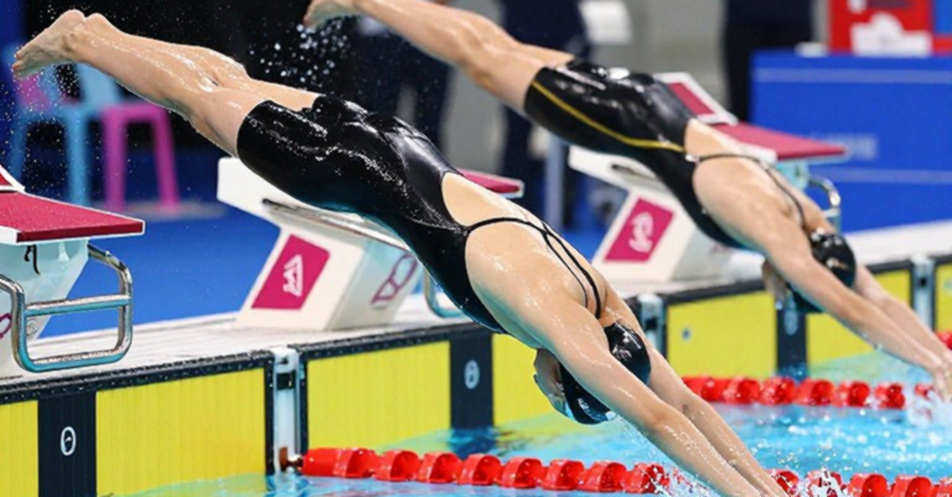
To analyse technique in a lane, I need the stroke: freestyle, breaststroke, backstroke, butterfly, medley or relay. I need the distance. I need to know which phase is at issue — the start, reaction time, the underwater dolphin-kick segment, the turn, the touch. I need split figures: the first 15 metres, 5 metres into the wall, 5 metres out. I need stroke rate and distance per stroke. None of it is there.
The technical dimension therefore lands in a state worse than data poverty: it has no subject. Data poverty can be fixed by going out and finding data. A missing subject means every sentence written is fiction.
Performance is worse still. A result means something only when placed in a coordinate system: world record, all-time list, current-season ranking. With no time column, there is no coordinate system. And without one, the gap calculation against world-record pace — the half-second threshold of the world elite and every tier beneath it — becomes impossible.
25-metre pools, 50-metre pools, and one blank cell that collapses every comparison
This is where I want to linger, because the lesson is universal.
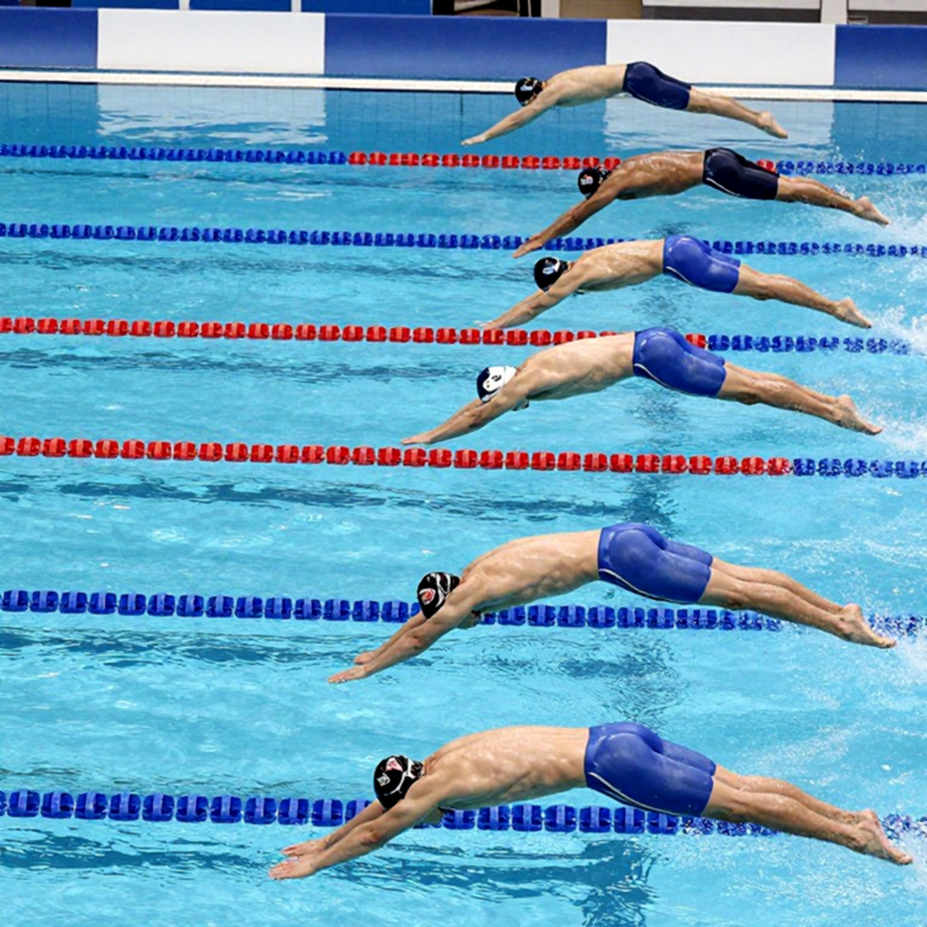
Short course (25m) has twice the turn count of long course (50m) over the same distance. Every turn is a push off the wall, and the push off the wall is the largest source of free speed in the sport. World Aquatics ratifies separate records for the two pool types for exactly this reason. Which means: if I do not know which pool a time was swum in, I am not permitted to compare it with any other time. The bar here goes beyond «be careful»: it is a prohibition.
In that empty extraction, the pool-condition cell is blank. One blank cell, and the entire second dimension of the framework is void.
The polyurethane filter
In 2026, at the World Championships in Rome, 43 world records fell in eight days. That number reflects a generation of suits more than a generation of swimmers. From 2026, World Aquatics banned full-body polyurethane racing suits, and every all-time ranking compiled since must pass through a filter: which marks belong to the high-tech-suit era, which to the textile era.
That filter needs exactly one thing: the year of competition. The empty extraction has no year. So the filter cannot run, and any all-time ranking quoted from it will be systematically wrong — always in the direction of inflation.
The cost of a non-Olympic year
The competition pyramid runs from the Olympic Games down to the long-course World Championships, the short-course World Championships, the World Cup series, continental meets, and national championships. Each tier serves a different function: training run, qualification, selection, or peak delivery. A result at a national trials and a result in an Olympic final are two classes of asset that cannot be converted into each other.
Worse, the four-year cycle imposes a discount rate every analyst must apply: an Olympic year carries full value; the year after an Olympic year is an adjustment year, where results are heavily discounted because athletes routinely swim through meets in heavy training. Without a year, I cannot distinguish a training-run swim from a peak-form signal. In swimming, that confusion is the most expensive error available.
Selection mechanics deserve their own paragraph, because this is where the three biggest models diverge most sharply. The United States uses «top two on the day» at Trials — brutal, transparent, and the source of famous selection shocks. Australia follows a trials model but adds discretionary federation slots. China uses a comprehensive-evaluation model, in which a time is one input rather than the whole verdict.
Those three models produce three different risk profiles: the US model maximises the risk of a single-day shock; the comprehensive model maximises the risk of bias; the trials-plus-discretion model maximises the risk of controversy. To know which risk an athlete faces, I need that athlete's federation. One data field. It unlocks three dimensions at once.
The power map, and where Vietnam sits
The world map of swimming has one main axis: powers with overall depth, nations built on a single-point breakthrough, and countries that dominate in clusters. The United States occupies the first pole through the NCAA pipeline — a university system that turned swimming into a scholarship industry with hundreds of high-quality competitive slots each year. The second pole is nations with only a handful of medal-calibre individuals, concentrating resources on them. The third is the cluster model: strong in two or three events, effectively invisible everywhere else.
Where does Vietnam sit? The honest answer is the second pole, and thinly. Nguyen Thi Anh Vien once put Vietnamese swimming on the map almost single-handedly, with her place at the Rio 2026 Olympics. Nguyen Huy Hoang then opened a distance cluster with a silver medal in the 1500m freestyle at the 2026 Asian Games. That is the single-point breakthrough model, and it has a structural weakness: it depends on one person.
I must state the boundary clearly: those two names appear here as context, not as evidence for any conclusion about a specific athlete in that empty file. Context and evidence are different things, and mixing them is the fastest way for an analysis to destroy itself.
Rule boundaries and the four tiers of an allegation
In swimming, the three most frequent technical-foul zones are the 15-metre underwater rule, the single-dolphin-kick restriction in breaststroke, and the starting-device regulations in backstroke. Add the one-false-start-equals-disqualification rule — changed in 2026, and a fixation for every sprinter ever since.
On anti-doping, my discipline is four separate tiers: confirmed violation; contamination dispute; procedural violation; and pure public-opinion allegation. Those tiers carry entirely different legal and reputational consequences. Blurring them is the fastest way to turn an analysis into an indictment.
In the empty file there is not a word about doping. That is a silence. And silence inside a defective extraction is the most dangerous thing there is, because it may mean «nothing happened», or it may mean «the most important thing was lost at the reading stage». I am not permitted to choose the interpretation that suits me.
The puberty barrier, and a shield that will not run
This is the part I regret most while holding an empty dataset.
In women's swimming, the puberty barrier is the highest-value risk screen in my entire system. Adolescent physical development changes body proportions, propulsion and feel for the water; many age-group records never convert into senior results. A 14-year-old swimming very fast may be a generational talent, or may be swimming on a temporary biological advantage. Those two scenarios require completely different advice, and telling them apart needs four data points: age, sex, event, and a performance series over time.
The empty file has none. Which means that if the source article concerned a teenage female swimmer, this dimension — the only one with a protective function — was disabled precisely where it was most needed.
In the other direction, for a senior male swimmer, the professional risk triad is swimmer's shoulder, breaststroker's knee, and a narrow peak window. Shoulder is cumulative stroke-volume injury; knee is the consequence of repeated breaststroke kicking; the peak window in men's swimming generally falls between 22 and 27 depending on distance — earlier for sprints, later for distance. Without age and distance, I cannot place an athlete anywhere on the curve.
The real risk sits in the process
My entire risk matrix returns null. But one risk stays at High, and it belongs to no athlete: the fabrication risk carried by the analyst.
I rate it High for three reasons. Production pressure is real and does not disappear when the data disappears. A confident piece built on empty data is harder to detect than a poor piece, because the reader has no way to verify a number that does not exist. And most importantly: if this empty extraction is passed into an automated downstream summary, it will surface as «no risks identified». That is a complete inversion of meaning — from «nothing could be read» to «nothing was there».
Medicine has a name for this failure when it happens to a test: a false negative. Sports analysis has no name for it, so we keep making it.
A label that cannot be falsified
Swimming is haunted by a style of label: «the next Phelps», «the next Ledecky». The label survives because it is nearly unfalsifiable. Falsifying it requires two things: split data for the athlete in question, and a historical coordinate system at the same age. The empty file has neither. So across the entire space of this analysis, the label cannot be caught out.
That is why I always ask one question before writing about anyone under 18: what does the data prove that contradicts the crowd? If the answer is «nothing», then writing the piece is no longer analysis. It is amplification.
The ripple chain and the missing link
Swimming has an unusually clear ripple chain: star effect flowing into children's swim classes, into the market share of racing-swimwear brands, into broadcast-rights value, and into the legacy of pools built for a Games. Tracing that chain needs five to ten factual anchors. The empty file has none.
But one structural point holds: in that chain, the middle node is the athlete and the meet. Without the middle node, upstream and downstream have nothing to transmit through. Sports-industry analysis fails exactly here — jumping straight from policy to market, skipping the middle node, and producing a causal chain that sounds plausible but has no link in it.
The contrarian angle
And here is where I break from the crowd.
An empty dataset is worth more than a fabricated full one. A nine-dimension report stuffed with numbers would make the editor nod, make the reader believe, and bury the broken stage at the very bottom of the pipeline. An empty file screams. It forces the extraction to be fixed before the next item is processed.
When the stands are empty, every model collapses. I rebuild from the burnt data. This time the burnt pile holds exactly one fragment: the domain label «swimming». That fragment is not useless. It proves the classifier ran correctly — meaning the system failed partially, not totally. In diagnosis, knowing what is still alive matters as much as knowing what is dead.
I once treated the model as scripture. Now it is only a compass — but without it, we are lost. And a compass with no needle is best set down, rather than spun very fast so that it points somewhere.
The transfer market is the only place where people pay for expectation rather than present value. Data analysis runs on the opposite law: expectation has no price until it carries a reliability label. In the transfer window, rumour is a commodity. In the data room, rumour is an unverified row.
Signal for the next cycle
Six data points would unlock roughly 80% of this framework: article title, source outlet, publication date, athlete name, event with distance, and one performance figure or one explicit claim. Six fields.
My signal for the next cycle is very specific: whether the re-run of the extractor returns a proper name. If it does, this analysis begins. If it does not, the right answer remains today's answer — and today's answer is still worth printing.
Reputation is only a name. What remains is always the way you read the race, even when nobody has swum it yet.